
Francisco Villagrán de León*
Versión en español aquí.
The OAS Permanent Council learned about the political situation in Guatemala on July 19 when the report of the Electoral Observation Mission (OAS/EOM) was presented. This report made an objective evaluation of the development of the electoral process, with clear and precise indications about anomalies that were observed by the mission. These included a review of the official tallies of the results of the elections as well as a series of legal actions aimed at disqualifying the process itself and eliminating Movimiento Semilla’s candidate, Bernardo Arévalo, from the second round of voting on August 20.
Subsequently, at the request of Antigua and Barbuda, Canada, Colombia, Chile and the United States, a special session of the Council was held on July 26 to examine the events in Guatemala after the June 25 elections, including interference by different institutions in the post-electoral phase through actions that seem to anticipate greater conflict and that seriously threaten the transparency and even the implementation of the second round of voting.
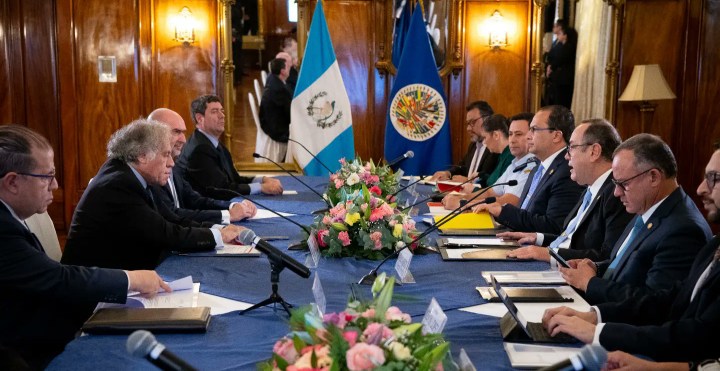
At that July 26 meeting, the Secretary General informed the Council that he would go to Guatemala in the following days at the invitation of its government, indicating the seriousness of the political situation in the country. He was present in Guatemala from July 31 to August 4, meeting with government authorities, the Supreme Electoral Tribunal (TSE), the two candidates who will participate in the second round of elections on August 20, and with representatives of civil society.
In the last six weeks there have been a series of legal actions –some of them criminal in nature– taken by the Public Ministry against the Supreme Electoral Tribunal and the Semilla party, actions that were unusual and violated Guatemala’s Electoral and Political Parties Law (this law, which has constitutional status, establishes that the TSE is the highest authority in electoral matters, independent and not subject to any State entity). This confrontation between state institutions has given rise to an intervention by the Constitutional Court and has in turn generated a more intense political and institutional crisis, which is likely to have a serious impact on the second round of elections.
In addition to the above, a criminal court decreed the provisional suspension of the Movimiento Semilla party, something that is expressly prohibited in the Electoral and Political Parties Law (“A party may not be suspended after an election has been called and until it is has been held.” Article 92). The Constitutional Court annulled this temporary suspension, and Semilla has filed appeals and an injunction that have not yet been resolved.
This political and institutional crisis constitutes an alteration of the democratic order and, under Article 20 of the Inter-American Democratic Charter, should be examined by the Permanent Council:
“In the event of an unconstitutional alteration of the constitutional regime that seriously impairs the democratic order in a member state, any member state or the Secretary General may request the immediate convocation of the Permanent Council to undertake a collective assessment of the situation and to take such decisions as it deems appropriate.”
At the same time, the recent visit of the Secretary General to Guatemala at the invitation of the Guatemalan government should be considered part of an initial evaluation of the situation in the country under Article 18 of the Charter:
“When situations arise in a member state that may affect the development of its democratic political institutional process or the legitimate exercise of power, the Secretary General or the Permanent Council may, with prior consent of the government concerned, arrange for visits or other actions in order to analyze the situation.”
The crisis is worsening day by day, with new judicial actions by the Public Ministry that seek to weaken the electoral system as a whole and intimidate its authorities and actors at all levels (including election workers at polls throughout the country as well as data-entry workers who enter the results into the TSE computer system). The Public Ministry, the state institution responsible for criminal investigation and prosecution, has assumed the power –which it does not legally have– to undermine the electoral authority and weaken its role as a governing body. The other state bodies (the Executive, Congress and the Supreme Court) remain conspicuously silent, waiting for the electoral process to collapse.
Given this situation, a strong message from the OAS Permanent Council is necessary through a resolution that contains a statement of support for the Electoral Tribunal, a condemnation of the judicial actions against it and against the party that received the necessary votes to participate in the second round of voting for president and vice president, as well as a clear warning of an imminent decision by the Council to activate all the mechanisms provided for in articles 20 and 21 of the Democratic Charter on the defense and preservation of democracy. The situation that is being experienced in Guatemala requires this.
In addition to the above, the Permanent Council should request the Secretary General to designate a special mission to accompany the transition process until the president-elect assumes office on January 14, 2024, provided that this election is free, transparent and duly recognized as such by the OAS/EOM. This is necessary to ensure international verification of that process and support for the elected government. The mandate and nature of this support mission should be different from that of the OAS/EOM, whose function ends once the results of the August 20 elections have been formally certified.
*Francisco Villagrán de León is former Ambassador of Guatemala to the United States, the UN and the OAS.
Photo: Agencia Guatemalteca de Noticias (AGN) vía Twitter

 Justicia en las Américas
[…] English version here. […]
Me gustaMe gusta